
Last reviewed: 31 October 2026.
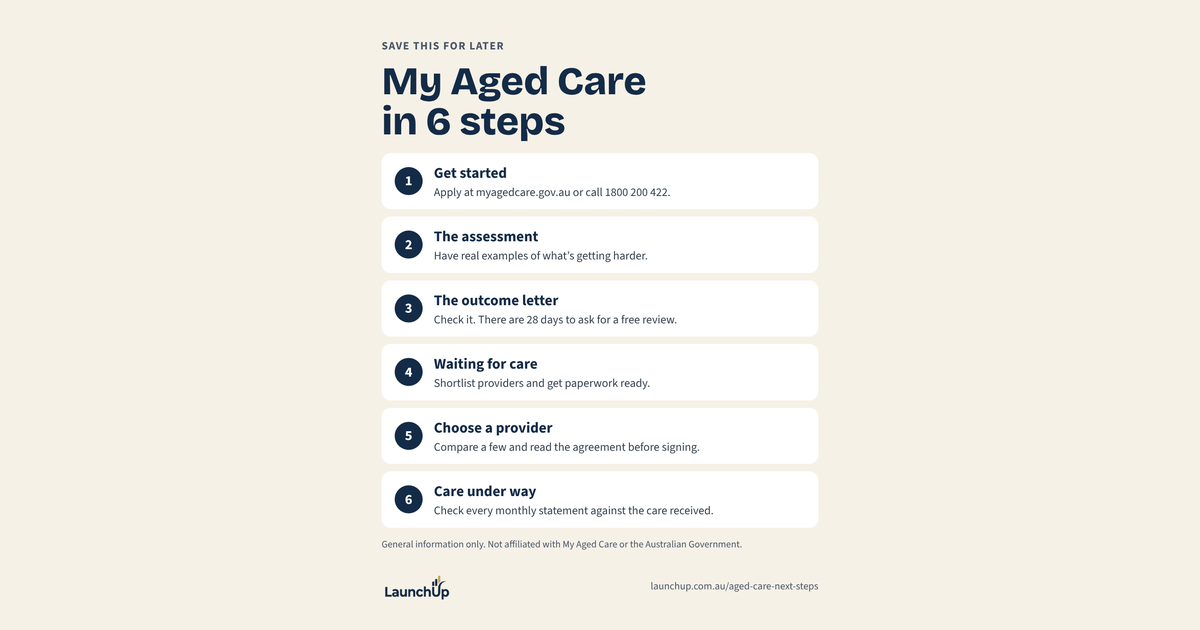
If you’re helping a parent or partner get more support at home, the first big step is a My Aged Care assessment. Many families still call it an ACAT assessment. This guide shows how to apply, what happens at the assessment, and what comes next, in six plain-English stages.
1. How to apply for My Aged Care
The My Aged Care application is the first step. Your parent can apply themselves, or a family member can help with their permission. There are three ways in:
- Online at myagedcare.gov.au
- By phone on 1800 200 422 (free call, Monday to Friday 8am to 8pm, Saturday 10am to 2pm). See what to say when you call.
- Through a GP or hospital, who can make a referral
Have the Medicare card handy, and decide who in the family will help. Your parent can register a family member as a registered supporter, who can ask for and receive information and pass on their decisions. This role replaced “representatives” on 1 November 2025.
2. The My Aged Care assessment (once called ACAT)
An assessor will contact your parent to book a time, then talk about how they’re managing day to day. Everyone is asked a standard set of questions. Being prepared helps the assessor see your parent’s real needs.
Documents to gather:
- Medicare card, and pension or concession card if your parent has one
- A list of current medicines (or the boxes)
- GP’s name, practice and phone number
- Names and contacts of any specialists or allied health workers
- Details of any help already received, paid or from family
- Recent hospital discharge papers, if any
- Registered supporter details, or legal arrangements such as an enduring power of attorney, if they exist
Write down real examples of what’s getting harder: washing and dressing, cooking and shopping, cleaning and the garden, getting around the house and any falls, getting to appointments, remembering medicines, feeling lonely, and how much family is helping now.
Your parent can choose to have a family member, friend, carer or registered supporter with them. A tip: people often describe their best day. Encourage a typical day, including the harder ones. Before the assessor leaves, ask what happens next and when the outcome letter should arrive.
3. The outcome letter (Notice of Decision)
After the assessment, a Notice of Decision arrives with a copy of the support plan. A registered supporter gets them too.
| Part of the letter | What it means |
|---|---|
| The decision | Whether your parent is approved, and for which services |
| Classification level | For Support at Home, the level of ongoing funding approved |
| Priority | How urgently funding is expected to be assigned, which affects the wait |
| Support plan | The services discussed and agreed at the assessment |
| Referral code | A unique reference number a provider uses to see the support plan. No code can mean your parent is waiting for funding |
If it doesn’t match what was discussed, there are 28 days from receiving the letter to ask for a free review. The key dates guide explains how.
4. Waiting for Support at Home funding
If your parent is approved for ongoing Support at Home but has no referral code yet, they’re in the Support at Home Priority System, waiting for funding. A funding letter arrives when it’s available. Use the wait to get ready:
- Check whether an income and assets assessment is needed. It works out what your parent will contribute towards some services. On the Age Pension or another means-tested Centrelink or DVA payment, usually no form is needed: just keep details up to date through myGov or on 132 300. Otherwise, complete the Support at Home calculation of your cost of care form (SA456).
- Shortlist 3 or 4 providers using My Aged Care’s Find a provider tool, and ask early whether they’re taking new clients in your parent’s area.
- Agree who in the family will call providers and go to meetings.
- If needs change a lot, such as a fall or hospital stay, contact My Aged Care.
5. Choosing a Support at Home provider
All Support at Home services come from one provider, so compare a few. Talking to providers doesn’t commit your parent to anything. Ask each the same questions:
- Are you taking new Support at Home clients in this area right now? If not, how long is the wait?
- What do you charge for each service, and for care management? Are there other fees, such as travel?
- Will my parent usually see the same workers?
- How will the family be included, and how do we raise a concern?
Get the service agreement in writing and read it at home before signing. Once funding is available, there are 56 days from the date on the funding letter to find a provider and sign. You can ask My Aged Care for another 28 days to find a provider.
6. Care under way
Once services start, the provider must send a monthly statement, even in a month with no services. Check each one against the care actually received, and review the care plan regularly as needs change.
Keep it all in one place
Aged Care Next Steps turns these six stages into a step-by-step plan built around your family, with call scripts, checklists, a provider shortlist and your key dates. Start your free plan. Stage 1 is free.
Questions families ask
Is a My Aged Care assessment the same as an ACAT assessment?
Many people still call it an ACAT assessment. Either way, it’s the assessment your parent books through My Aged Care to work out what support they’re eligible for.
Who can apply for a My Aged Care assessment?
Your parent can apply themselves, or a family member can help with their permission. A GP or hospital can also make a referral.
What is a My Aged Care referral code?
A unique reference number in the outcome letter. A provider uses it to see the support plan. If there’s no code, your parent may be waiting for funding.
How long do we have to choose a provider?
56 days from the date on the funding letter to find a provider and sign a service agreement. You can ask My Aged Care for another 28 days to find a provider.
Related: My Aged Care phone number and what to say · Support at Home funding and key dates · Personal care from 1 October 2026 · The paperwork nobody wants to do · Staying in your home
General information only, not financial, legal or health advice. LaunchUP is not paid by aged care providers and isn’t affiliated with My Aged Care or the Australian Government. Check details with My Aged Care. Sources checked 31 October 2026: My Aged Care: how to contact · Preparing for your assessment · Registered supporters · Receiving your assessment outcome · Connecting with Support at Home providers
Know someone weighing this up? Send it to them.
Share by Facebook Share by WhatsApp Share on LinkedIn Save to Pinterest Share by Email
One plain-English tip a week for Australians 55+ and the families helping them: follow LaunchUP on Facebook, Instagram, LinkedIn and Pinterest.